
3.0 Actions
By Jack Carter (W2R AUS) and Michael Harrington

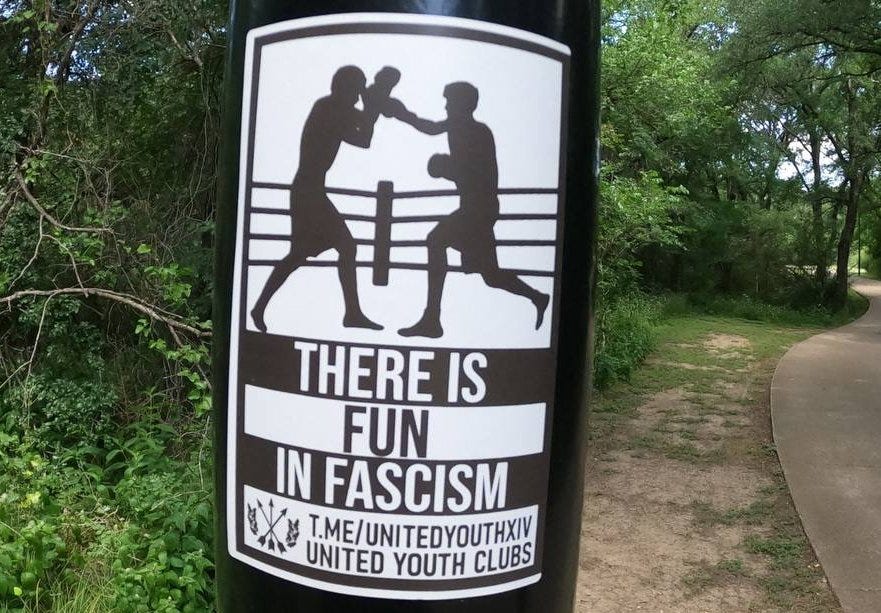
There are numerous methods of resistance within 3.0. The following is a list of actions Active Clubs can undertake should they choose to.
Postering, Leafleting and Stickering
Postering is one of the more traditional forms of activism guaranteed to produce the reaction required for recruitment, increasing community tension and exposing system corruption. It is low cost, low risk and the materials can be gathered with low exposure.
All you need is paper, a printer and a paste solution. The most common activist paste solution consists of flour, water and sugar (added after the flour has been reduced to a paste). This is known as wheat paste. Choosing a container for the paste can be tricky because it needs to be one that is easily accessible when on the move. After years of experience with various methods, as demonstrated by plenty of ruined rucksacks, the best container to use is a flask; just be sure to use a paintbrush with a long handle and a brush head that fits the width of the flask otherwise you’ll end up in a mess.
Leafleting is another traditional form of activism and all it takes is a printer. Simply print off the propaganda and either hand them out personally or leave them lying around on the floor, on doorsteps, seats of public transport and windshields.
Stickering is a more modern form of activism but is just as simple and low cost as the rest. All you need is a printer and some sticker-back paper.
Banner Dropping
Dropping banners can be very effective for spreading a particular message or raising awareness of something. Typically hung from motorway bridges or accessible buildings, banners are always reported on within a few hours of being dropped unless service workers have gotten to them before the daily commute has started, but this can be avoided by putting them in areas that require a ladder or a cherry picker.
There are two methods for obtaining a banner. The first is to commission someone to print it, which is very high risk and therefore not advisable. The second is to purchase a linen or polyester sheet in a colour of your choosing and design the banner yourself using stencils, paintbrushes and spray paint.
When dropping a banner from a location where zip-ties cannot be used, such as a building, you will need to weigh the banner down with bottles filled with water, sand, stones etc. or small weights tied to the corners of the banner with thin rope or paracord to prevent it from blowing away.
Graffiti
Tagging and stencilling structures or painting murals is medium risk, and unless you target a location that carries additional meaning or somewhere central and has a highly provocative message, it isn’t going to generate much attention. Anyone can tag. It doesn’t have to be symmetrical or fancy so long as the message is readable or the symbol is decipherable. For instance, tagging the Celtic cross, which is just a circle with a crosshairs through the centre slightly extended outside the circle’s circumference, is a good and easy symbol to tag or stencil.
Attention will start being generated among street artist and gang networks, but the reaction will be likely restricted to the fringe unless the message or symbol is particularly offensive or the art is displayed in a central location with substantial foot traffic.
Protest March
Protest marches are straight forward and simple, but have reduced in effectiveness and increased in risk over the years. Demonstrations are a gamble because they can either show strength or weakness, which can make or break an organisation depending on your numbers and the way your members handle themselves throughout the march.
The problems with protests are: (1) at least one member is going to become known to the police as a result of them having to give their address to the authorities when organising it with them; (2) the police often contact anti-fascist groups ahead of time to tip them off about the protest; (3) the media are also tipped off so they can prepare a narrative ahead of time; (4) police employ facial recognition technology at protests, which essentially results in your entire organisation getting doxed when the police later pass that information to the security services and those services then leak it to anti-fascist intelligence organisations like the ADL, SPLC and Hope Not Hate.
It is seriously not worth it just to take the microphone, potentially bash some Reds in self-defence and throw a Roman salute.
Flash Demonstrations
Flash demonstrations are the second most effective methods of generating attention or spreading a message fast. This is because unlike traditional protests, flash demonstrations don’t give advanced warning to the authorities and therefore counter-protestors can’t turn up. This is extremely high risk and requires methodical preparation and organisation to pull off without getting arrested, but all you need are no less than five men and a megaphone. You can add a banner if you want, but it just makes it harder to vanish before the authorities arrive, so we do not advise it.
Due to the limited time you will have (research police response times beforehand), it is important to make the speech as concise and uncompromising as possible to generate as much attention as possible. You don’t really have to concern yourself with potential fights because most people won’t interfere with five well-built men dressed in dark colours wearing masks; and if they do, all you need to do is open your palm and extend your arm in front of you with a bent elbow, hitting them once or giving them a hard shove if they push against your hand (demonstrating their intent to invade your personal space, which is grounds for self-defence due to a high probability of violence), thereby preventing further people joining in.
When it comes to organising a flash demonstration you need to plan your infiltration and exfiltration, and then plan a second and third exfil point in case the first and second is cut off. You also need to select a person to time the demonstration so it doesn’t come close or go over the police response time. The timer must give the signal to wrap up the demonstration at least 50 seconds before the police are set to arrive (1.5 minutes if area is crowded). This can be communicated with a simple tap on the shoulder of the speaker, followed by subsequent taps on the shoulders of the other men. Everyone must then stick together and make a hasty advance to the exfil point using methods of deterrence against members of the general public that try to detain you if necessary, such as shouting, warnings and self-defence methods mentioned above. You should be able to outrun a woman or some bugman chasing and recording you.
On an unrelated note, we have heard stories of activists just grabbing phones and throwing them a good distance to give the recording party something else to think about, but as professional and civilised representatives, naturally we oppose criminal damage with every fibre of our being. It is absolutely unthinkable, completely beyond the pale. Why it’s so incomprehensible that we’d be inclined to compare it to a certain event involving 20th century orchestras, swimming pools and pyjamas.
Occupying
Occupying is a strategy synonymous with left-wing activists and is the highest risk but also the most effective method of activism. All you need to do is storm or infiltrate a building and take over a location within it, preferably with a balcony so you can maximise public attention. You then deploy flags, drop a banner, give a speech and drop countless leaflets on the public below. The reason why this tactic is associated with left-wing groups is because you will get arrested for trespassing, intimidation and public nuisance without a doubt and left-wing groups have NGO lawyers on retainer, whereas we generally do not.
It’s also likely that the authorities and media would try to spin it as a hostage situation if a “far-right” group tried it, so if you do decide on this method make sure you state clearly and loudly that the people within the building are free to leave at any time; state once when entering and again when a crowd has gathered.
We do not recommend government buildings as you could have another January 6th on your hands. Instead choose businesses that the local government has contracts with, businesses that support your enemies or businesses that are the subject of public ire.
Tension Targeting
Tension Targeting is an action that aims to increase the tension and instability within a non-homogenous or varied belief community through various actions like those listed above. The only objective of those prior mentioned methods is to stoke a low-trust atmosphere, reveal division in the community, or expose anti-White attacks by non-Whites and the misconduct of the globalhomo system. The general rule of thumb is that with Tension Targeting you target the symptoms, not the cause; whereas with every other objective you target the cause, not the symptoms.
An excellent example of Tension Targeting is infringing upon an Antifa stronghold area by tagging over their murals and stickering over their stickers. This communicates to the people of the area that social cohesion is a myth because there are rival political factions fighting over the area, thus directly attacking the globalhomo narrative that falsely states Western civilisation is unified in its tolerance and progressivism.
Conclusion
There has been several tactics presented within this article for Active Clubs that want to get involved in political activism. It is not compulsory for Clubs to get involved in the activist business; for simply maintaining, training and cultivating your own crew of active white men is more than most people are doing, but it’s there for Clubs that want a taste.
As always, you decide your own level of involvement.
All Fascists are bastards